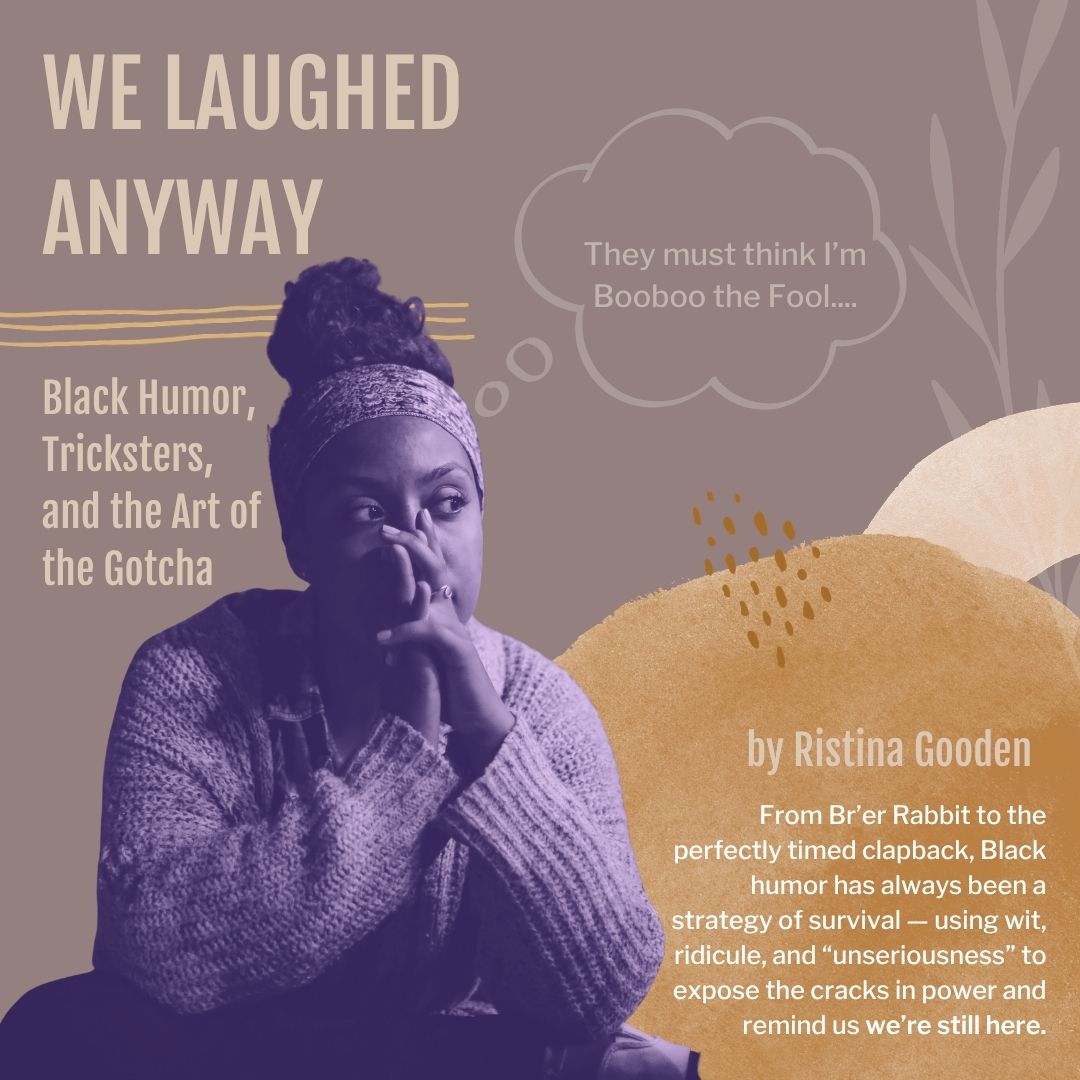
We Laughed Anyway: Black Humor, Tricksters, and the Art of the Gotcha
How Brer Dog Lost His Beautiful Voice (A Modern Day Recap)
Once upon a time, Brer Dog had a beautiful voice. The kind that could stop a porch full of folks mid-sentence. The kind that made Miss Saphronie lean forward in her chair, calling out for just one more song. Brer Dog would sit under the chinaberry tree, banjo in hand, voice smooth as evening air, singing his way into her attention.
And Brer Rabbit?
Well, he was there too. Cross-legged on the porch.
Trying. Failing.
So one day, down in the piney woods, Brer Rabbit stopped Brer Dog and said, “You sho got a mellow voice. Wish I could sing like that.”
Brer Dog, a little proud but not quite satisfied, leaned in.
“I do wish I could sing enough to suit Miss Fronie.”
And that was all Brer Rabbit needed.
“I know a way to make your voice sweeter,” he said.
All Brer Dog had to do was open his mouth.
And so he did.
And in a flash—razor out, tongue split—Brer Rabbit tore off through the woods, leaving Brer Dog behind, voice ruined and rage-filled, chasing him ever since.
That’s why, they say, the dog barks the way he does now.
And why he’s still mad.
The Wisdom of the Trickster
Before we rush to make Brer Rabbit the villain, we need to slow down. Because in Black folklore, the trickster is never just one thing.
Brer Rabbit is not moral in the way we’ve been taught morality should look. He is not concerned with fairness. He does not play by the rules. In fact, his whole existence depends on his ability to bend them. Because the world he lives in is not fair.
The trickster emerges in conditions where power is uneven, where survival is not guaranteed, where the rules were never made for you to win. In those conditions, you develop another kind of intelligence — quick, improvisational, a little bit sideways.
You learn how to read the room. How to spot an opening. How to make something out of nothing. You learn how to win without power.
That’s what Brer Rabbit is doing. Not just being mischievous,but practicing survival. Outsmarting, outmaneuvering, refusing to accept the terms as they were given.
It’s not always pretty. But it is effective.
That same spirit lives on. Not just in stories, rather, in us.
In the way Black folks laugh at things that should break us.
In the way a single line can shift a whole room.
In the way we can look at something deadly serious and say,“Now you know that don’t make no sense.”
Black humor is not accidental.
It is resistance.
Because systems like white supremacy depend on being believed. They rely on a kind of performance — of authority, inevitability, control. They need you to take them seriously, even when they are built on contradiction.
And humor?
Humor disrupts that performance. It pokes at it. Tilts it sideways. Exposes the seams.
Sometimes it’s loud — a full-bodied laugh, a joke that lands hard.
Sometimes it’s subtle — a look, a pause, the still air after a read.
You know that moment. When someone says exactly what needed to be said, so clearly, so precisely that the room goes quiet.
That’s more than comedy, it can even be revelation.
There is a reason marginalized people have always been accused of being too much, too loud, too unserious.
Because unseriousness, in the right hands, is dangerous.
To laugh in the face of something that is supposed to intimidate you is to break its spell.
To joke about something that demands reverence is to question its legitimacy.
To play with the rules is to reveal that they were never fixed to begin with.
Black unseriousness might look like ignorance on the outside.
It’s really clarity.
It is knowing the stakes and still choosing to breathe, to laugh, to create. It is refusing to let violence have the final word on how we experience our lives.
Brer Rabbit runs off, leaving Brer Dog behind, voice changed forever.
It’s not a “clean” story. It’s not a moral tale in the way we were taught to expect. But it tells the truth about the world we live in.
Sometimes survival looks like outsmarting.
Sometimes it looks like disruption.
Sometimes it looks like a well-timed laugh.
In a world that insists on its own seriousness — its hierarchies, its violences, its false claims to power — Black folks have always carried another set of tools.
Care. Story. Joy. And yes, humor sharp enough to cut.
So when the laughter comes, when the read lands, when the room goes still for just a second, don’t rush past it.
That might be the moment when something false starts to fall apart, and something truer slips through.
Upcoming Event: Womanism Around the Table
Want to talk more about tricksters and Black humor? Join us for Womanism Around the Table with special guest Starlette Thomas from The Raceless Gospel on Thursday, April 30, 6 – 7:15 PM ET // 3 – 4:15 PM PT. Register here.