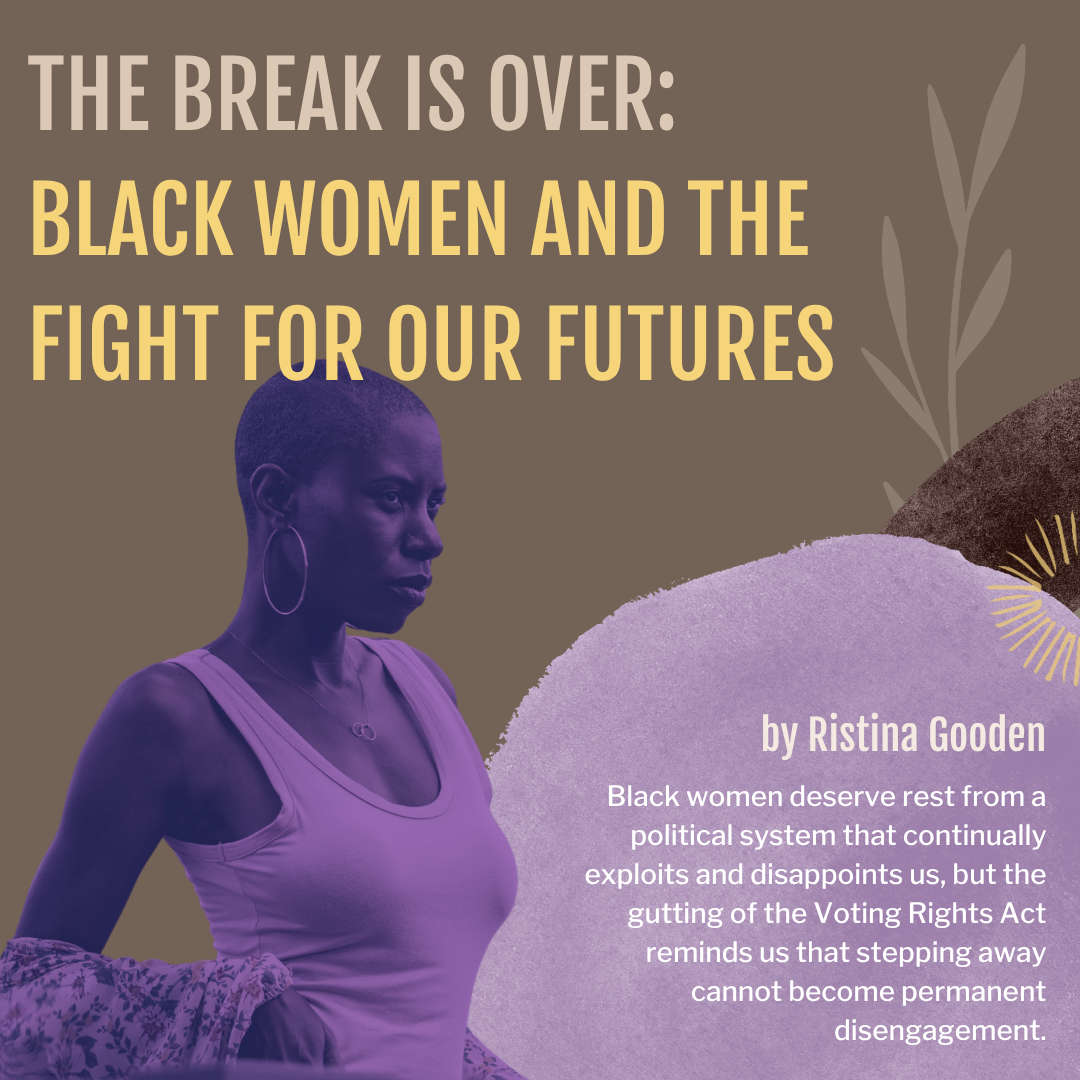
The Break Is Over: Black Women and the Fight for Our Futures
When the news broke on April 29, 2026 that the United States Supreme Court had effectively gutted the 1965 Voting Rights Act, my first thought was simple: are the 92% ready to get to it?
And I don’t mean that as a shade. I mean it honestly.
Since the 2024 election results came in, there has been an unrelenting flood of think pieces, podcasts, and social media discourse centered on Black women retreating from the American political machine. There was plenty of talk—some of it in jest, all of it weary—about us “resting,” about “saving ourselves this time,” and about no longer carrying this democracy on our backs after Kamala Harris lost the election.*
And truthfully? I understood it.
Black women have always been the mules of the world, expected to save everybody while barely being allowed to save ourselves. As Alice Walker reminds us, “A womanist is not a separatist, except periodically, for health.” And Black women’s health — physical, emotional, spiritual, economic — is under constant attack.
Over 300,000 Black women lost jobs over the last year. Black women continue to experience devastating rates of maternal mortality and pregnancy-related complications. Housing, food, gas, and childcare costs continue to rise while wages remain stagnant. Femicide, especially violence against Black women and femmes (Nancy Metayer Bowen, Cerina Fairfax, Tammy McCollum, Ashanti Allen, Davonta Curtis, and Barbara Deer to name a few) continues with horrifying regularity, often without sustained attention.
Black women are carrying heavy loads. So if some folks needed to step back from the endless churn of political catastrophe on this stolen land, that makes sense to me. Rest is necessary. Disengagement, at times, is survival.
But breaks cannot last forever. And if we’re honest, it’s time to tap in. Not because we owe this country another rescue mission, we do not. Black women are not democracy’s unpaid labor force. But because too much is at stake if we disappear from the fight altogether.
We live here too. We are part of this nation’s fabric, even when this country refuses to fully recognize our humanity. We have the right to demand that our voices be heard and our expectations enacted. And while change never happens overnight, we have watched decades of organizing, policy, and hard-won protections dismantled in a matter of months. We cannot afford political hopelessness.
Our ancestors certainly could not. They organized under conditions far more dangerous than many of us can imagine. They strategized around kitchen tables, church basements, beauty salons, and union halls. They built networks of survival and resistance because they understood something we must remember now: freedom work is rarely glamorous, and almost never convenient. When one strategy failed, they regrouped. When one law was struck down, they organized again. When one door closed, they made another way. That is our inheritance too.
And this moment requires us to think beyond ourselves. Choosing not to engage politically does not only impact those of us who still have access to the ballot. It also affects those whose voices have already been stripped away — particularly incarcerated and formerly incarcerated people who remain disenfranchised long after serving their sentences in a system that disproportionately criminalizes Blackness and poverty. Our undocumented immigrant kindred, still under attack with Black women among them, have no political voice. We must fight for them too.
We know the dismantling of voting rights never happens in isolation. Once the right to political participation weakens, other rights become easier targets. We have already watched the unraveling of reproductive protections after the fall of Roe v. Wade. We are living through the erosion of affirmative action, attacks on public education, growing restrictions on bodily autonomy, and increasing efforts to narrow who gets to belong fully in public life. These are not disconnected issues. They are coordinated efforts to determine whose lives deserve protection, freedom, and possibility.
But let me be clear: this is not a call for “Black girl magic,” Black Superwomanhood, or exceptionalism. Those narratives have exhausted us for far too long. We do not need to be superheroes to deserve dignity. We simply need to continue doing what Black women have always done: love the folk by committing ourselves to the survival and wholeness of entire people.
That commitment is not passive because love is not passive. Love is a strategy. Love is showing up. Love is organizing. Love is telling the truth. Love is protecting futures we may never fully live to see ourselves. And yes, love is also rest. Joy. Boundaries. Care. We cannot fight for the world while abandoning ourselves in the process.
A womanist response to this moment is not martyrdom. It is sustained, collective, and deeply rooted action grounded in the belief that our lives, and the lives of our people, are worth fighting for.
So yes, rest when you need to. But then gather the folks. Go back to the drawing board. Back to the committee meetings. Back to the group chats and dinner tables and organizing calls.
Because the work is not over.
And neither are we.